Overclock
A downloadable game
Arkanoid meets Ikaruga meets rhythm-defence, on an infinity symbol.
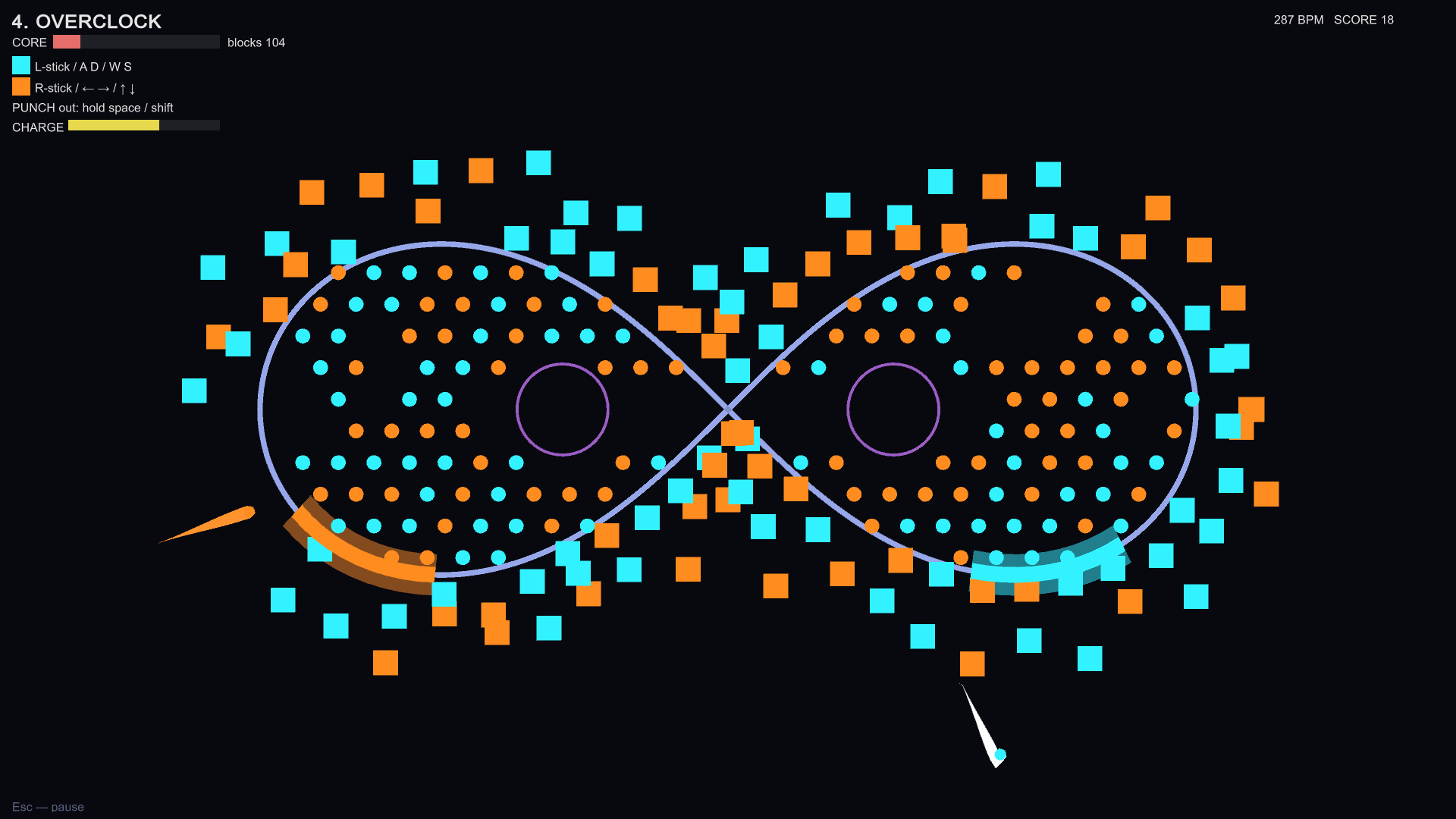
You are not defending a line at the bottom of the screen. You are guarding the entire rim of a figure-8 — with both hands.
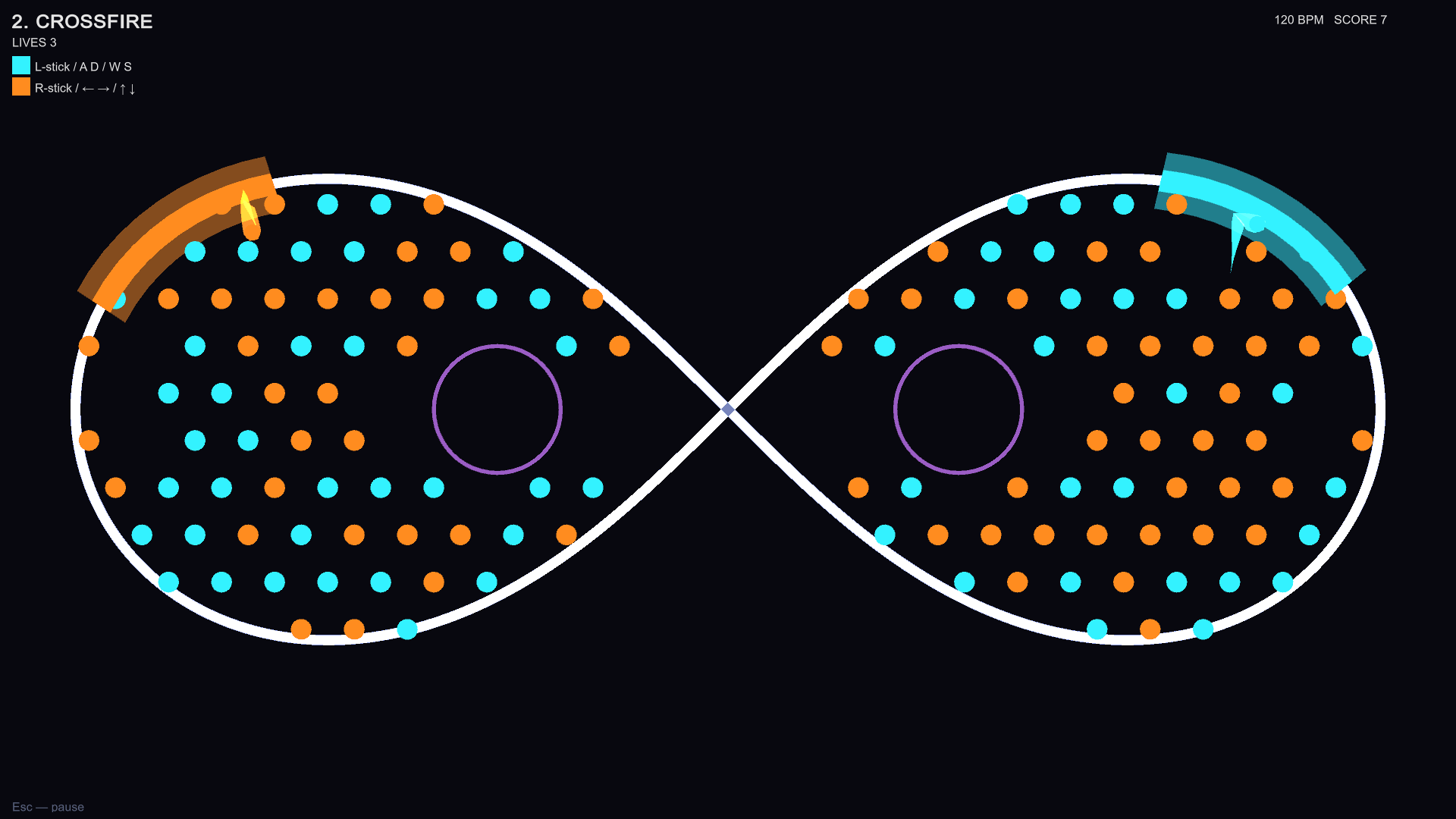
Two balls are live at once, one cyan and one orange, caroming around the two lobes knocking out pegs. You have two paddles, each a fixed colour, each on its own stick: left stick drives cyan, right stick drives orange, and a paddle only catches its own colour. You are effectively two ships at once, with each hand responsible for one ball.
THE COLOUR RULE
The pegs are coloured too, and a peg is only cleared by a ball of its own colour. A wrong-colour ball caroms off it pinball-style and leaves it standing. So half the board is off-limits to each ball at any moment.
The way you reach the rest is the portal at the centre. It grabs a ball, forces it across to the other lobe, and flips its colour on the way through. That makes crossing both a hazard and a tool: a save on one side becomes your other hand's scramble on the far side, but it is also how you recolour a ball to go after the pegs you couldn't touch before.
THE MUSIC IS THE CLOCK
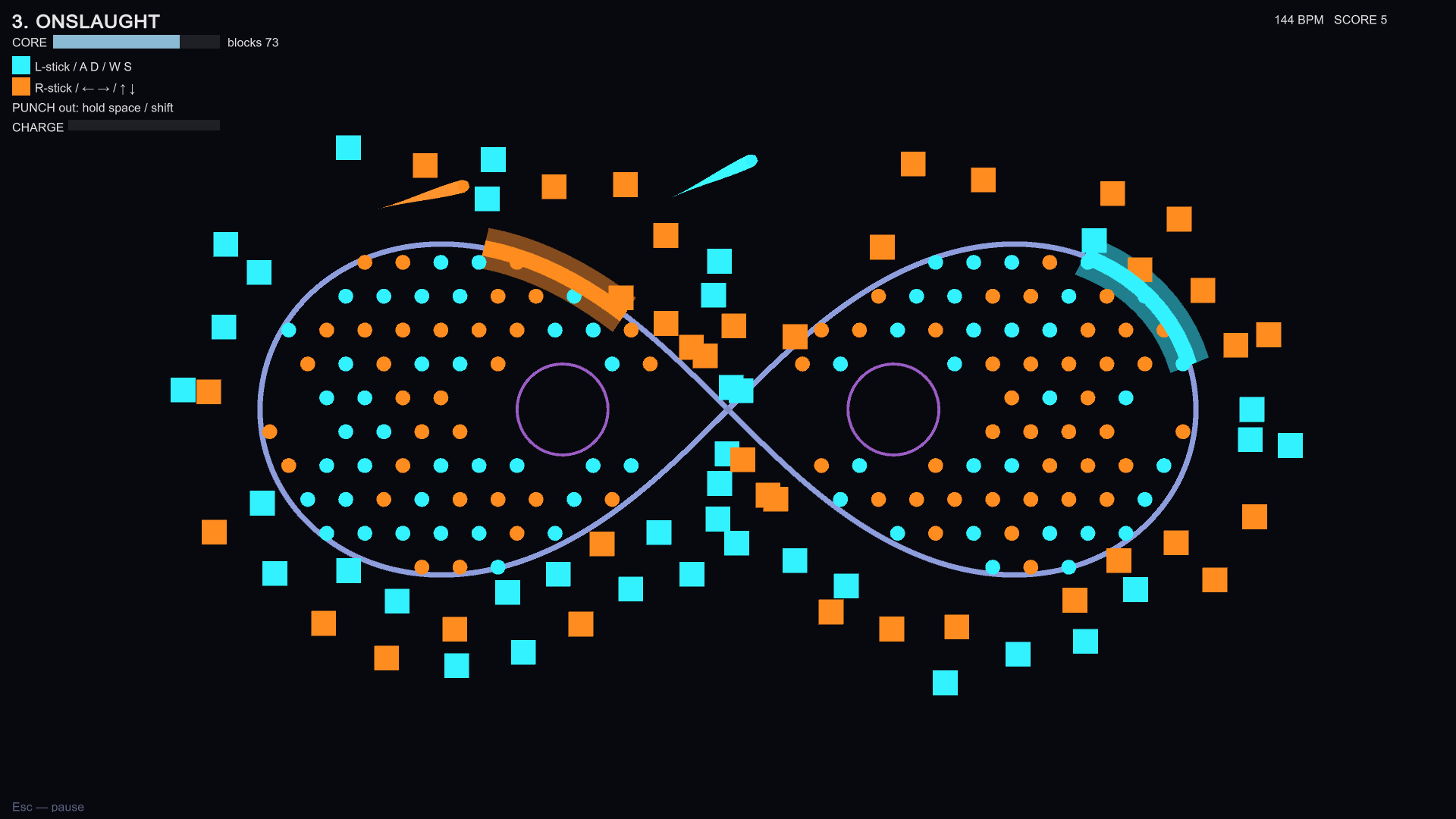
In ONSLAUGHT, rings of coloured blocks march inward from outside the arena — one lurch per beat of the track that is playing. A block that reaches the rim breaches your core.
To fight them you punch a ball straight through the paddle membrane into the faster combat space outside, where it smashes matching-colour blocks. Meanwhile, clearing pegs on the inside charges you up, and a full charge arms the next ball out there to detonate — it blazes white and its first kill takes out a whole cluster.
Mine the calm space to fuel the frantic one. And because the wall marches on the beat, the track's BPM is literally the difficulty.
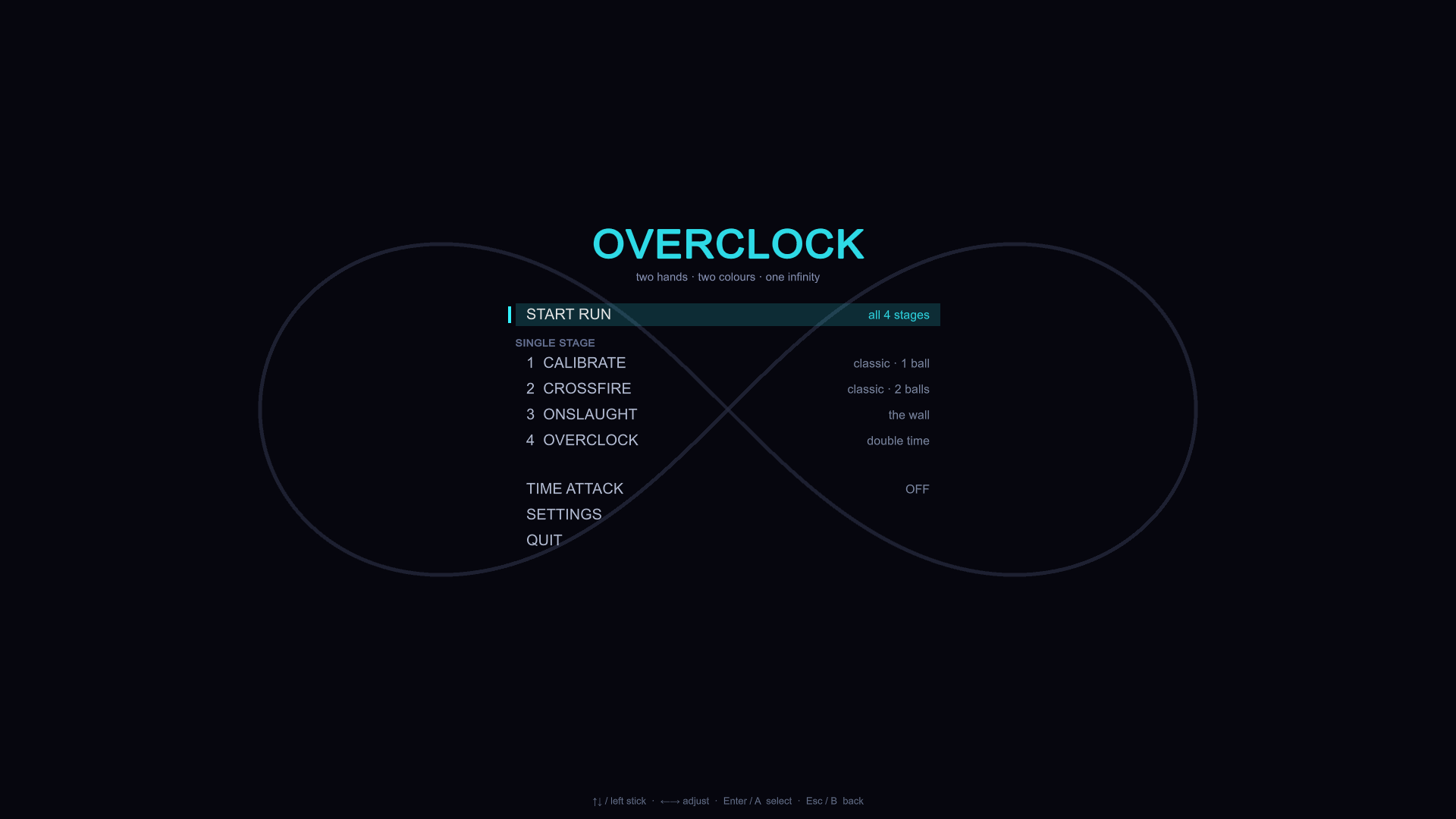
FOUR STAGES
1. CALIBRATE — 96 BPM, one ball. Learn the rail, the colour match, and the portal handoff.
2. CROSSFIRE — 120 BPM, two balls, denser board, fewer lives.
3. ONSLAUGHT — 144 BPM. The wall, the punch, the core, the charge loop.
4. OVERCLOCK — the same track, marching on eighth notes, with a deeper and denser wall. The music doesn't get faster. You do.
Play the whole run, or pick any single stage as its own mode. TIME ATTACK is a toggle rather than a separate mode, so it works on one stage or on a full run, and keeps your best times either way.
CONTROLS
Gamepad is strongly recommended — two-stick hand independence is the whole point.
Cyan paddle — left stick, or A / D, or W / S
Orange paddle — right stick, or Left / Right arrows, or Up / Down arrows
Punch a ball through the membrane — hold Space or Shift (ONSLAUGHT only)
Advance / retry — R
Pause — Esc
In menus: Up/Down or the left stick to move, Left/Right to adjust a setting, Enter or A to select, Esc or B to go back. The mouse works too.
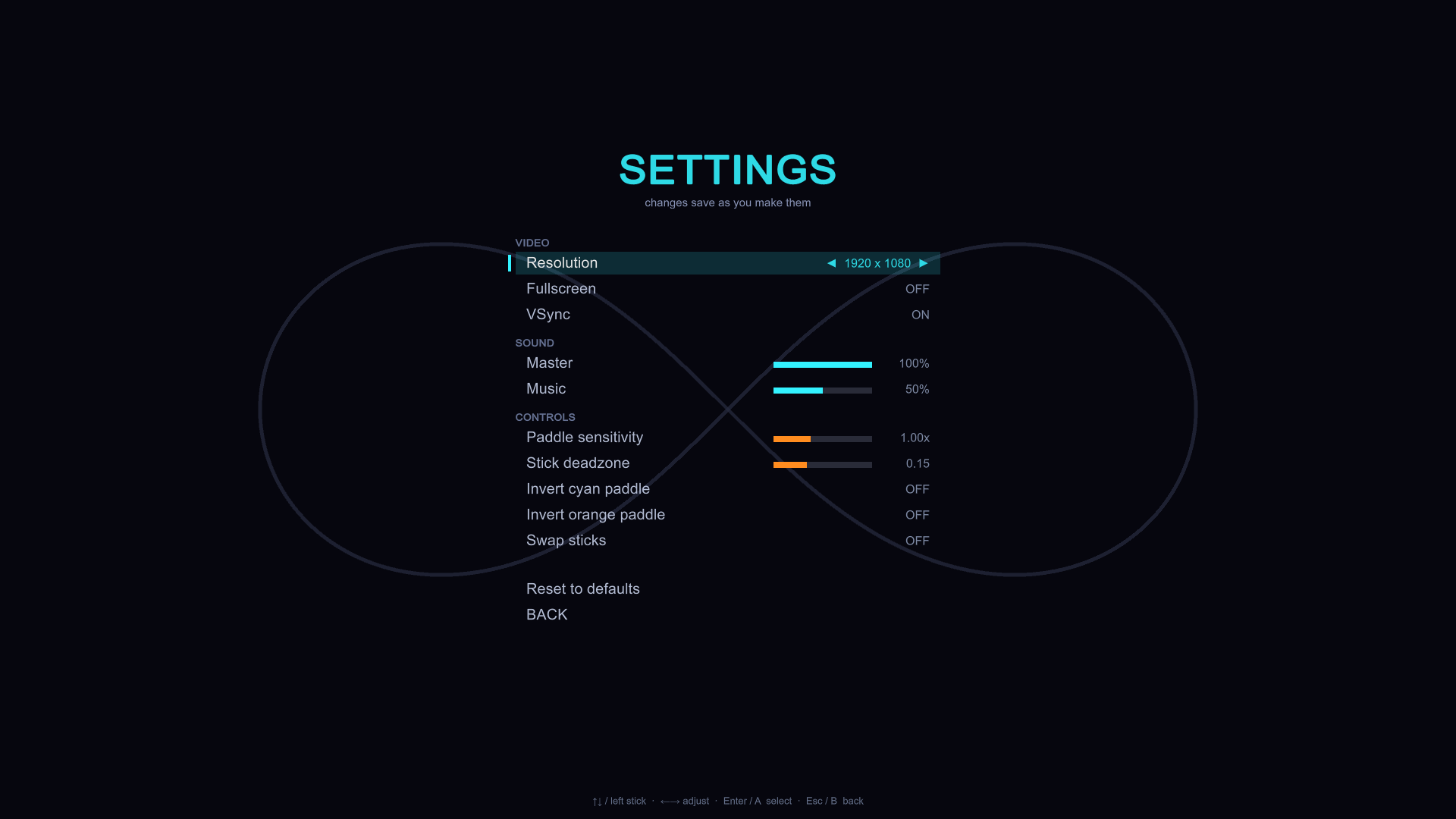
Settings cover resolution, fullscreen, vsync, master and music volume, paddle sensitivity, stick deadzone, per-paddle invert, and swapping the sticks.
UNDER THE HOOD
There is no art in this game. Every peg, ball, paddle, block and line you see is generated from maths at runtime.
The arena is a Bernoulli lemniscate — F(x,y) = (x²+y²)² − 2a²(x²−y²). The two lobes are exactly where F is negative, so "is the ball still in play" is one cheap evaluation, and the gradient of F is the wall normal to bounce off. No physics engine, no colliders, no rigidbodies. The paddles ride the rail by arc length so they move at constant speed all the way round instead of bunching at the tips.
The neon is additive blending on a near-black field rather than a post-processing stack — overlapping bright colour adds toward white, which reads as bloom for free.
The soundtrack was generated locally with ACE-Step, and the game clocks itself off the audio hardware's own clock (dspTime) rather than the frame clock, so the wall never drifts out of sync with what you're hearing.
HONEST NOTES
This is an early build (0.1.0) and it plays like one.
- High skill floor, on purpose. Two-stick independence is hard, and that is the game. The first stage is deliberately gentle.
- No sound effects yet — the music is in, the hits and clears are not. That is the next thing.
- The difficulty curve has been tuned by arithmetic more than by playtesting. Feedback on where it spikes is genuinely useful.
- Windows only for now.
Download
Leave a comment
Log in with itch.io to leave a comment.